teaching work
monday and tuesday were holidays, so this was a short week.
exlab (26.3FA)
lecture. using my work with tata studi as an example, i explained how, with each iteration, designers raise fidelity or resolution or both. resolving work, to me, involves things like handling edge-cases. fidelity is about being faithful, and so raising fidelity involves making something appear-and-behave more like how it will finally be experienced.1
i think this was the first time i made ‘slides’ to explain a concept to students. it helped me stay on track, and keep the lecturing short ; so, i’m glad i did.
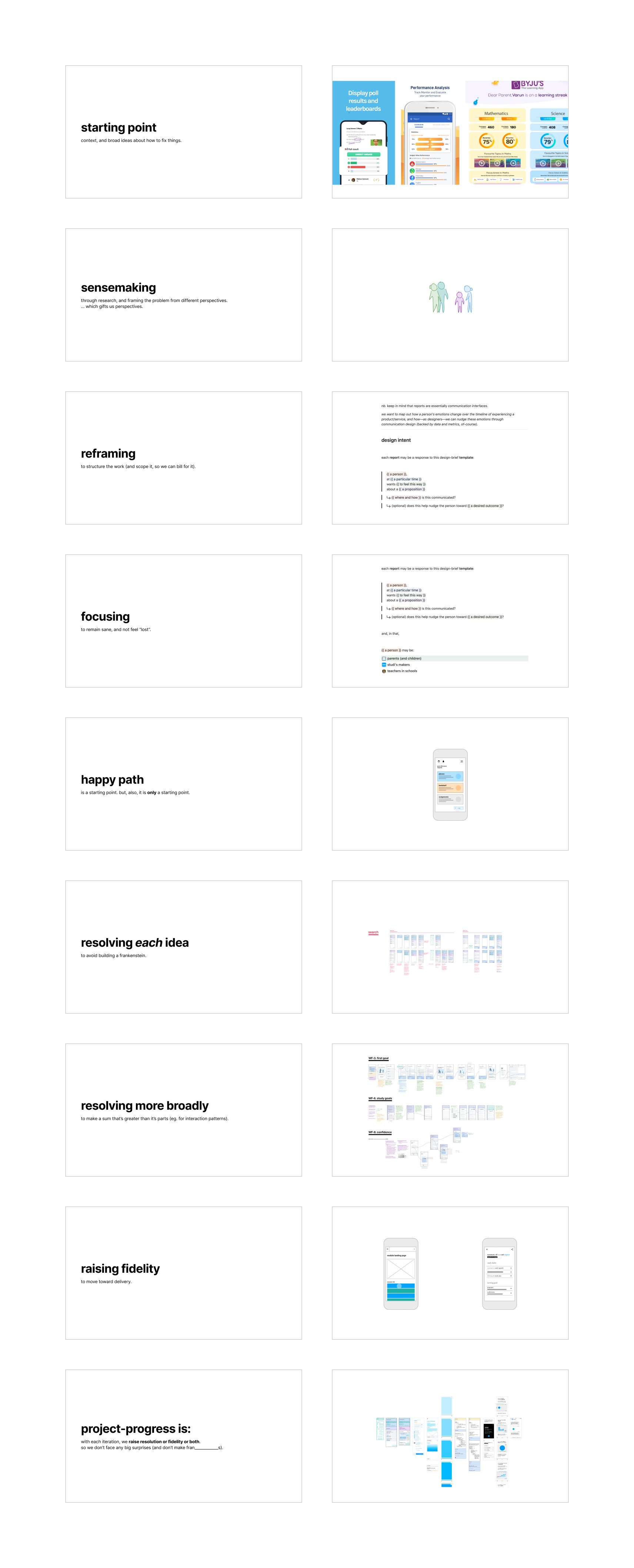
this was followed by much conversation. i worked with students to help them objectively bridge the jump from problem framing to ideation/prototyping. some students leap too far ahead, others suffer stuckness (usually caused by a lack of focus in their framing), and yet others are unable to articulate their intuition unto others ; so, i work with each one to tune their progress.
some students visited the purdue nursing simlab to watch nursing students undergo a simulation-training with laerdal manikins.
uxfun (26.3FA)
introduced terms2 like affordance, signifiers, feedback, etc.

i’m working on being more crisp with lectures, and peppering them with activities to keep students engaged. and i’m enjoying teaching more because i see fewer blank expressions (and sufficient chatter) in the classroom now.
students filled out group-work surveys, and i compiled midterm grades for the students.
behaviour hacking project (26–27)
we discussed problems (from our own lived experiences) which we will try and hack in the weeks ahead. armita shared how she controls her punctuality through dozens of pre-set alarms, and mabel discussed the procrastination we all experience in arranging clothes or washing utensils.
the root of problem isn’t always obvious in its symptoms, so i asked the students to think deeper and sideways to identify insights (as they sensemake through their problems).
i also emphasised how just making “stuff” is not enough ; as designers, we should [aim to] fix people’s behaviours and not simply the things they use.
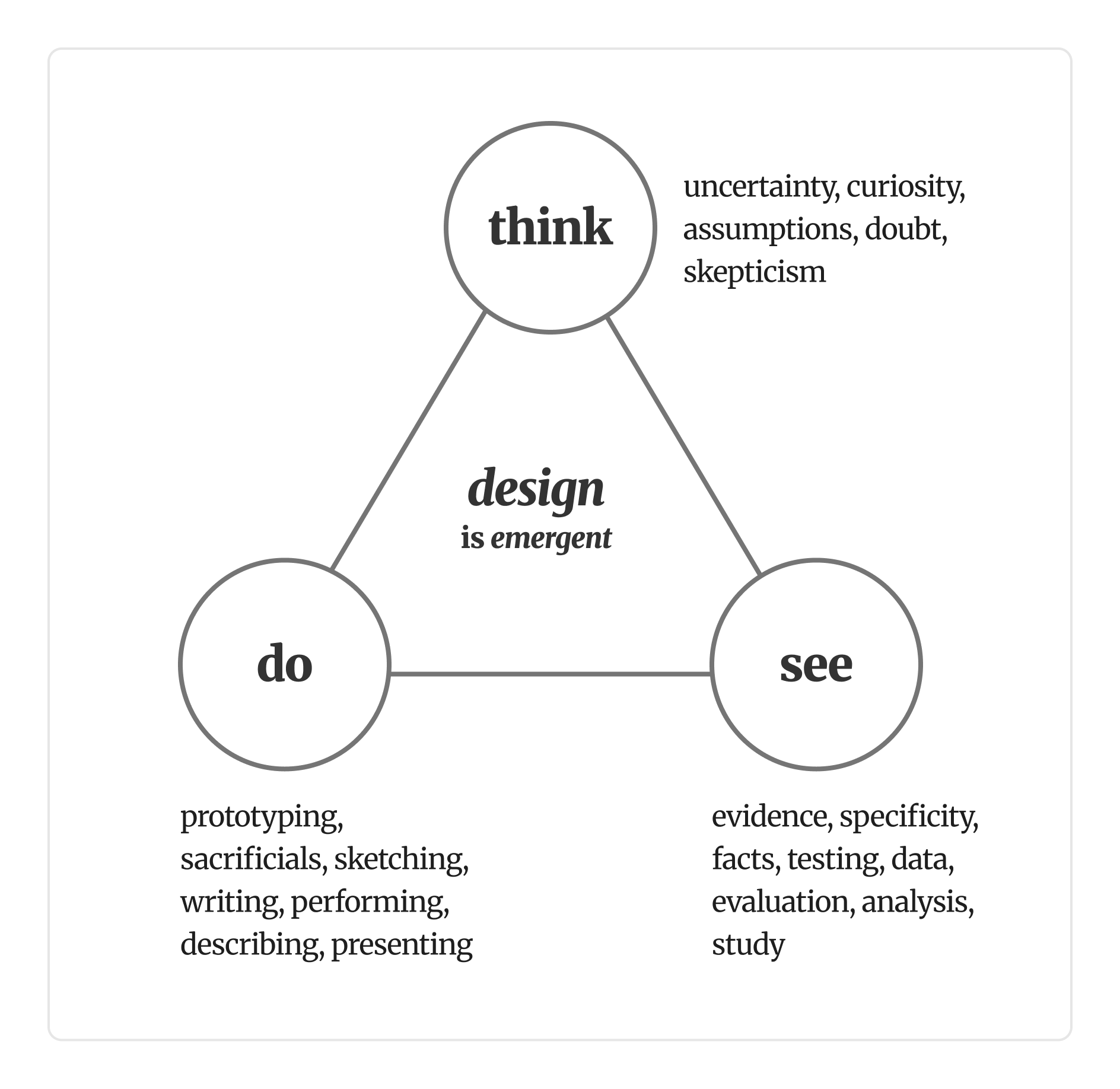
lastly: i encouraged them to ignore “process”, and pick whatever they want to do as their next step for the project. if they feel like prototyping a solution, they can ; if they feel like studying the problem in greater detail, they can do that too. as long as they don’t get “stuck” — just thinking, or just making, or just doing research — and keep shuffling between each such activity, they will be fine. i showed them this sketch ; although i know there are issues with many of the terms in there (and the representation is incomplete too), it’s still better to show this to students than to just ramble words to them.
other teaching work
was glad for my conversation with arjun-itp as he worked through his master-thesis. i could test my scaffolding for staging projects on him, and was glad relieved that it held up. during our chat, we discussed many things like:
- studiomonicker projects: crowdsourced sticker and animation installations, and logic-based drawing exercises. the conditional design workbook. reminded me of sol lewitt’s wall drawings (which “are usually executed by people other than the artist himself”), the related solving sol website.
- ideas around chinese whispers, message-received; and “there’s no doubt about it!”.
- david eagleman’s tedtalk in which he presented a wearable that lets you sense the stock market.
- anecdotes from the information (book, james gleick) about talking drums and claude shannon’s communication model.
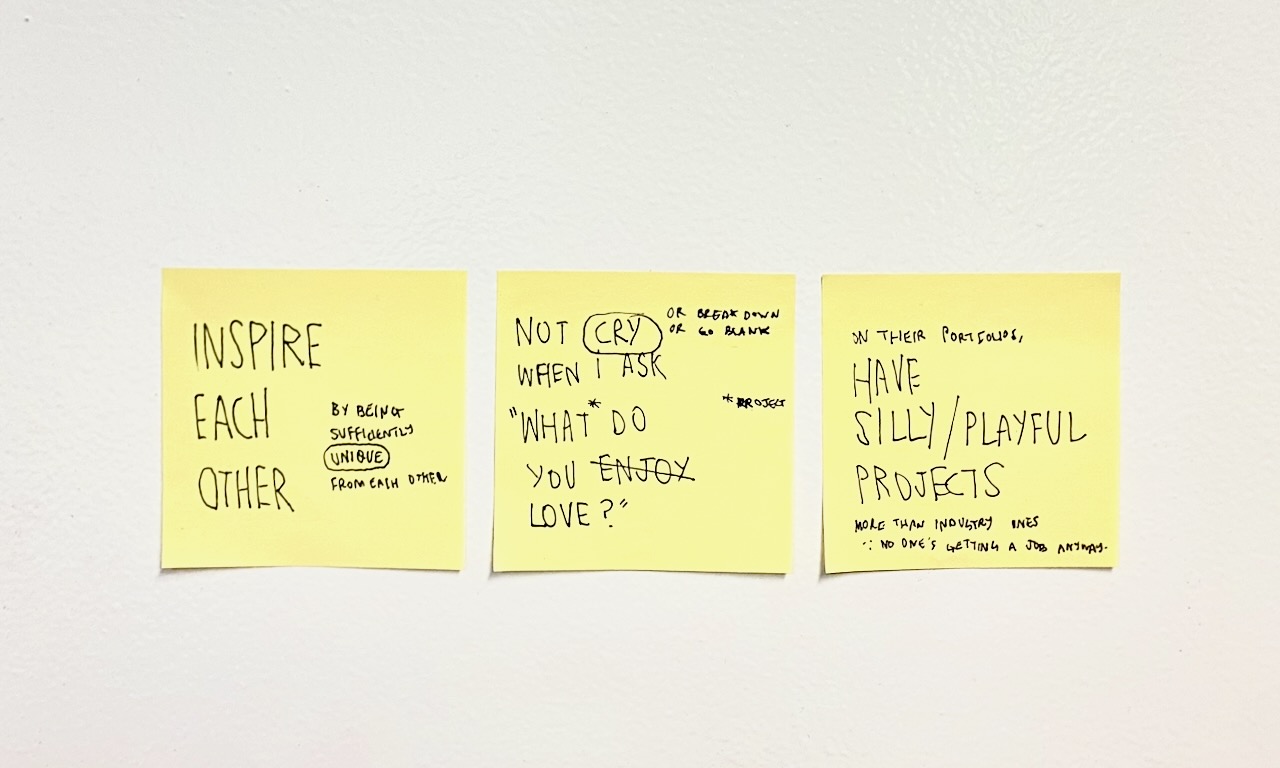
in a meeting to discuss the purdue ux design programme’s curriculum, when we discussed what skills we want our students to graduate with, my suggestions focused on culture. skills are important, but we mustn’t get so busy turning young adults into workers-for-industry that we forget what education can be about3.
absorbing
watched the opening bits of the ezra klein show: “is it wrong to love a chatbot?” with sherry turkle. (sherry studies relational artefacts like tamagotchis.) i’m noting down some quotes from the podcast:
we nurture what we love : we love what we nurture.
technological affordance in human vulnerability.
people come to a computer conversation primed with deep disappointment with the people around. (people lined up to talk to eliza; when sherry interviewed them, they talked not about the [computer] program but about how their partner never listened to them, how their mother was a bitch … they were filled with conversation about people in their lives who didn’t listen … and this was [a place] where you knew someone would.)
physical activity
bouldered once. strength and endurance are both low, but i am moving well.
badminton.
- i played well on monday. whichever team i was in lost the match, but instead of struggling to reach 8 or 10 points we’re now getting to 15 consistently. i need develop a backhand, because now they’re attacking that part of my game. (this is a good signal, because it means that my other flaws are not as easy to exploit any more.) i’m wasting ten points each game due to to unforced errors. i need to improve my distribution, smash more accurately, make my drop-shots cross the net, attack the net more intelligently, and serve more consistently. in the long-term, i ned to add more variety to my serves (but that’s probably a goal for next year).
- on friday: i was sleep-deprived, didn’t get a chance to warm up. so—duh—i played like poop.
annual physical check: blood tests, skin-cancer check, mental health survey, and a flu shot. doesn’t look like i’m dying any time soon.
social
spoke with shantanu joshi, and expressed how i feel administratively beleaguered but (largely) intellectually unstimulated at purdue.
spoke with arnab chakravarty. like rohit sharma did last week, he too helped me understand how much gen’ts have affected the playing field. we pranced-around this idea a bit:
now that it’s so much easier to make things, what is meaningful to make?
i believe this makes it althemore important for students to discover poetry and play in their educations.
miss has been busy for the past two weeks, and we’ve barely spoken. i was confident that i’d be fine without her, but i feel quite low. thankfully, i’ve enjoyed my work with students this week, and that’s helped.
she may soon be forced to trim her team; so, she has been stressing about planning career paths for the people she may need to let go. so i wrote her this:
my only feedback is: not to think about [multiple] different careers. do not (for your sake, but more so for each of them) give the impression that you are thinking “for” them. instead, ask them to go think [for themselves], and then to come back and share it with you. and when they do, ask questions that make them think more deeply about whether they’ve thought about “why”, and about whether they’re wondered “if not this, then what” enough times. so that they develop (through their own agency — and not yours) both conviction and a resilience for an uncertain future that they will need to face alone.
josh polk invited me to watch an american-football game at purdue’s ross-ade stadium. i loved the performances by purdue’s bands-and-orchestras in all the breaks, and i enjoyed spending time with josh; made me feel less alone for a while. as for the sport itself? before i went, i’d feared i wouldn’t like it : after watching it, i definitely do not. at-least five boys got injured (badly) during the game, and the violent nature of the game was appalling to witness. the stop-and-start nature of the sport and the commercial-breaks didn’t help either.
other
song of the week: “apt” by rosé and bruno mars (spotify).
Footnotes
-
an industrial designer may agree with me, but ux designers use these terms in a flipped manner. for them: resolution is about pixel-perfection — is this because they can’t get their heads out of the screen; because they think that the whole world is a pixel construct? —, and fidelity is about handling edge-cases etc. i refuse to subscribe to that notion, even if i am the only one. ↩
-
see: chapter 1 in don norman’s book, ‘design of everyday things’. ↩
-
jignesh wrote (in his pedagogical pocketbook) about how ‘education’ comes from the latin educere which means ‘drawing out from within’. i too have written about how education should be about self-discovery. and learning who you are (or even what you can do) necessarily involves play — testing limits, trying to overcome boundaries, feeling a thrill or unease, etc —, and we intuitively say “this place lacks culture” when we sense it’s absence. ↩