teaching work
exlab (26.3FA)
by the end of last week, students had identified several problems opportunities in laerdal’s lleap software. so i’d asked them to present their insights this week.
findings describe human behaviour, whereas insights describe the reasons behind that behaviour.1


however, they struggled to present their observations in the form of insights, and very quickly dovetailed into describing ideas and solutions instead. (several of their observations and ideas excited me, though; so i did get quite happy even if i wasn’t content.)
i realised three things:
- it is unfair for me to expect them to put in substantial work outside class.
- students don’t respond well to open-ended assignments.2
- even though they’ve gone through several courses (many of which involved industry-sponsored projects), they really haven’t learned how to move objectively from the discovery to ideation phase in a project.
(i may want and expect them to, and they likely should, but it is clear that most students in this programme do not; so i need to get my head out of my ass and respond to the reality i am confronted with. i know the students are capable; so—for now at-least!—i just need to find other ways to help them express and hone their abilities.)
so, i shifted gears, decided to work with them step-by-step, and helped them move from “observations” to “ideas”. (i’ve done this quite intuitively all my life without ever realising that there was a method to it ; so teaching is forcing me to reflect more deeply on *how* i do *what* i do well, so that i may help others do it too.)
- i studied all the stuff they presented last week, identified common patterns in it, and shared it with them.
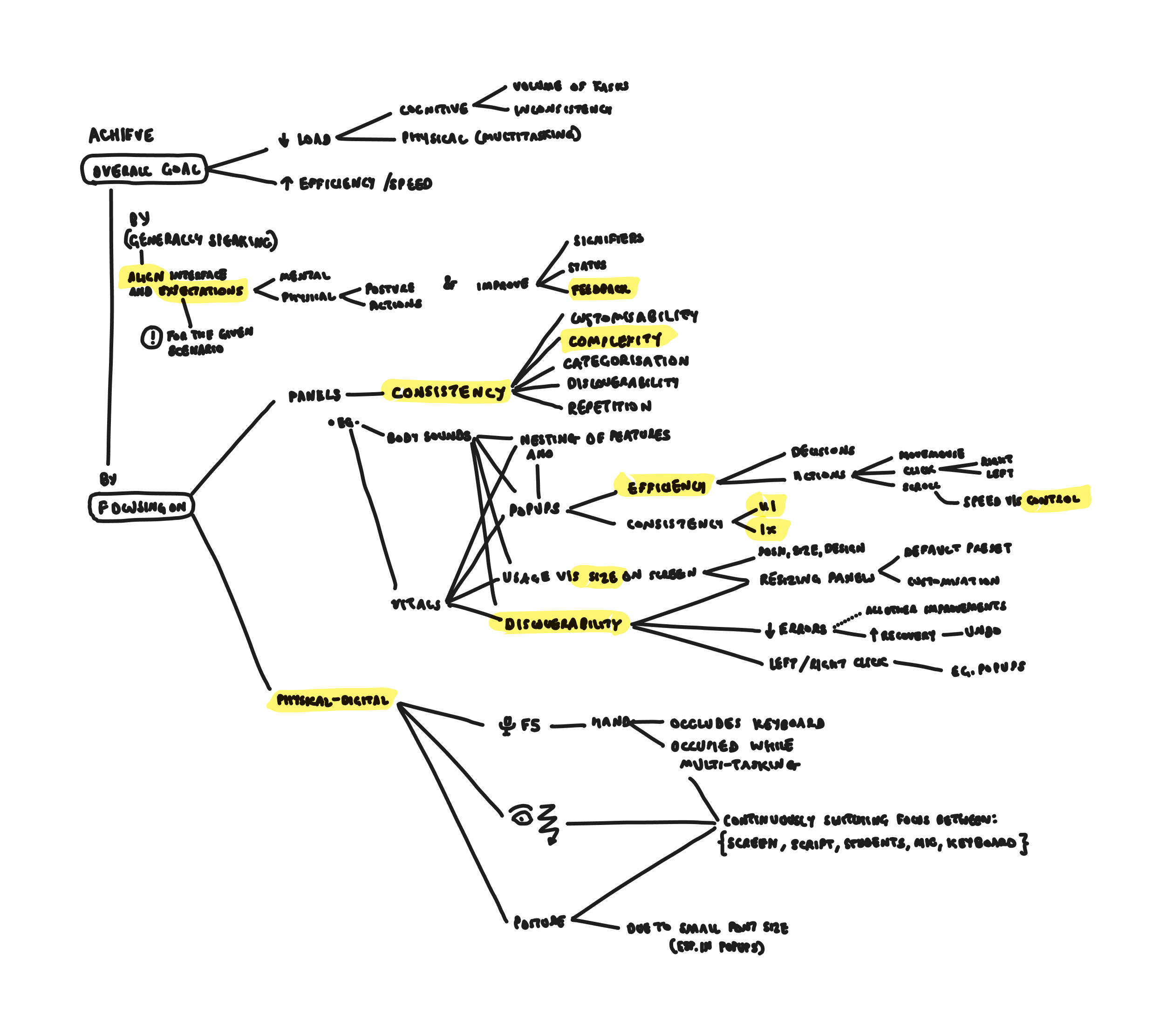
- made them do a 5-why’s exercise in class to go deeper below the observations.
- shared concepts and theories for them to read about: eg. modes, and the tirade against modes in the latter half of inventing on principle (talk, bret victor, 2012); fitt’s law; and other concepts described on bruce tognazzini’s blog.
- suggested using heuristics to arrive at keywords around which they can—next week—pivot from observations to ideas.
- introduced them to jira stories (and how they are not different from how might we statements), which can be used to frame a focus (i.e., define a goal before diving into ideation).
i also explained how they can use storyboards or journey maps to communicate their understanding to others, but shouldn’t get hung up on terminology or templates.
uxfun (26.3FA)
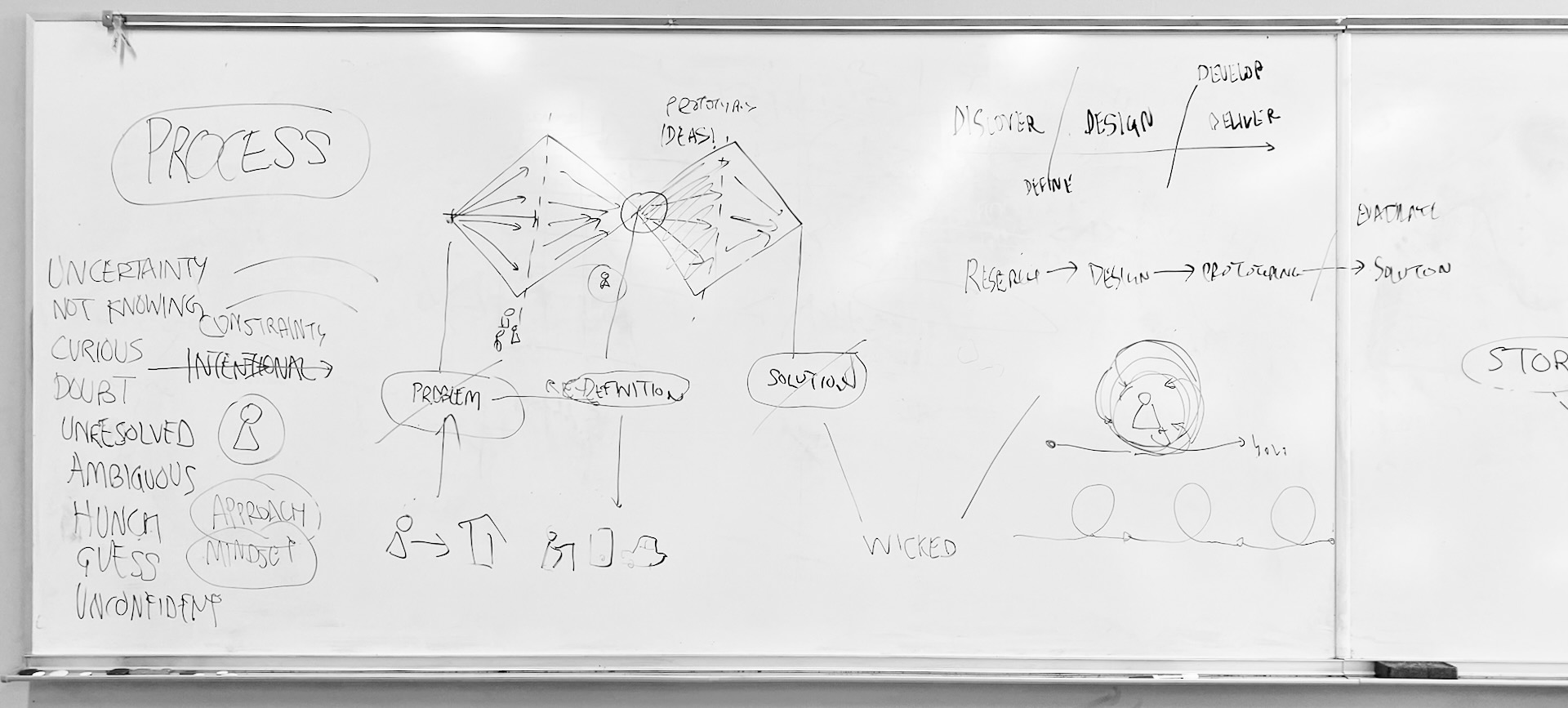
i started the week with a lecture on this: while design is sold as a process, designers should not reduce the 'approach' to a 'process'. just because a project-manager labels the first phase of a project as ‘research’ doesn’t mean that research only happens there. designers have to do whatever is necessary—and whenever needed—to move away from uncertainty, curiosity, doubt, bias, lack of resolution, ambiguity, etc (while respecting a project’s constraints).
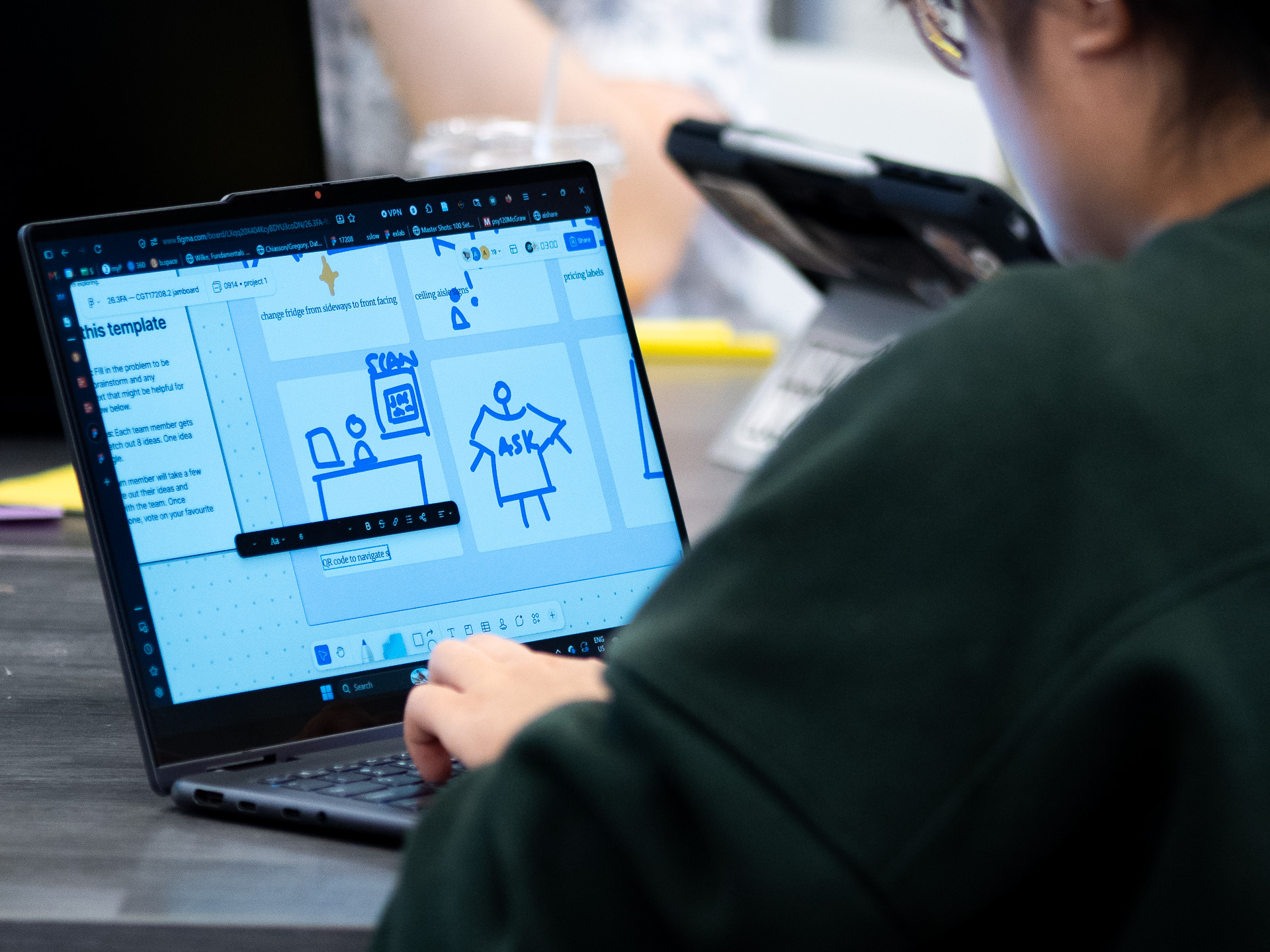
then we reframed our project-briefs to be focused and goal-oriented. that allowed us to segue into a crazy-eights rapid-eights3 ideation exercise where each member in a group drew eight ideas in eight minutes (ish). then they discussed and selected one idea to move forward with.


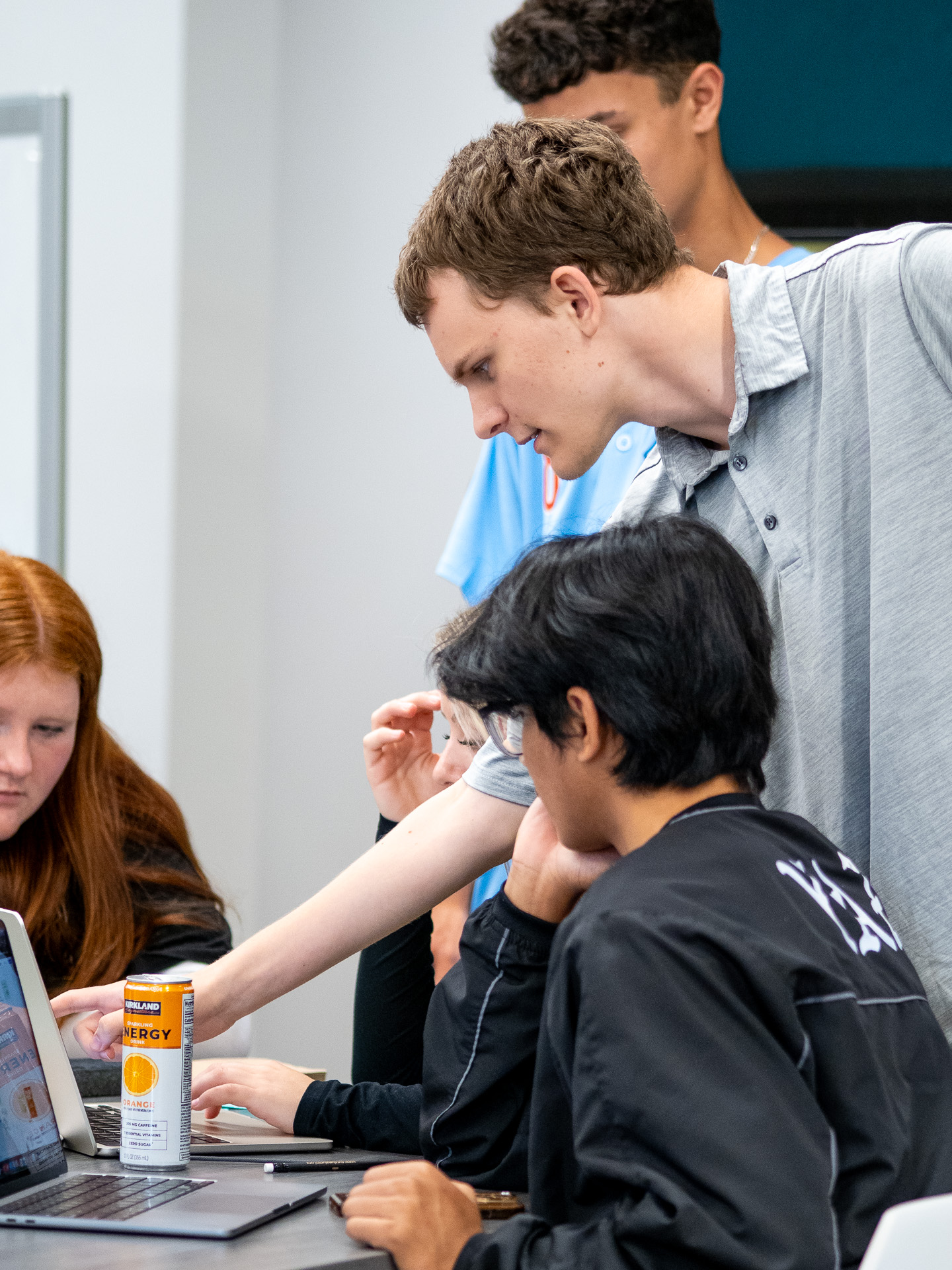
sienna wheeler noticed how me using the blackboard (instead of slides or figjam) was a good idea because—at-least for the first few minutes—students weren’t looking at phones or computer screens. (i continue to reflect on reducing lecture-time in class. this exercise, for example, could be done in 15 minutes instead of 25.)
our conversation also touched-upon a few other things, and triggered some broader thoughts45.
behaviour hacking project (26–27)
we heard a 2018 episode on rituals from bbc radio 4’s ‘the digital human’ podcast. our discussions post comprised words like alignment, structure, memorableness, transition. (made a note to start any future behaviour-hacking project/course with this podcast.)
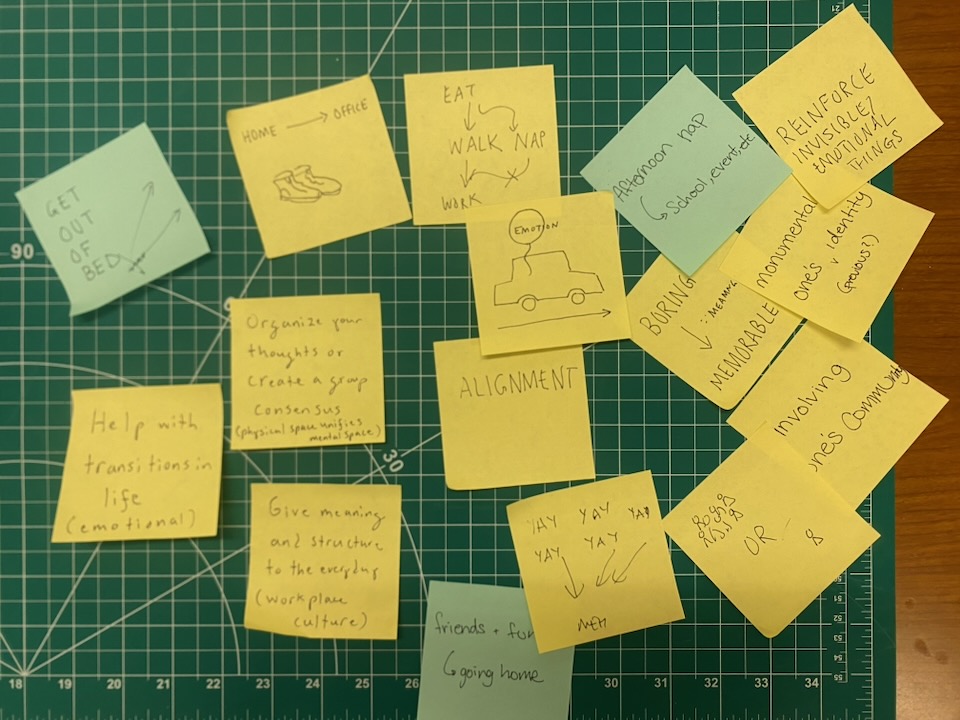
once we start to look at rituals as “vehicles of affect” (because they provide structure for people to reliably and memorably transition from one emotional state to another6), we can treat rituals as fungible, mutable, design’able artefacts.
as designers, we are goal-oriented: our machinations help transport the person’s emotions to a desired (goal) state while being context-aware, meaning-sensitive, and constraint-abiding.
rituals, themselves, are simply a subset of human behaviours. they are a convenient means to introduce students to behaviour-hacking since it is easy to identify all aspects of a behaviour-system in them. so, deconstructing rituals is a good starting point for behaviour hacking.
a behaviour system is a term i just made up to refer to a the designer’s understanding of…
- a situation: a person, a context and scenario, a goal.
- a choreography: what and how a person senses, interprets, understands, decides, expresses, and acts.
- and why any of this is meaningful to a person.
impact course
learned about single-line rubrics. practiced applying the terms autonomy, competence, and relatedness (from self-determination theory) to think more deeply about learning outcomes and objectives in a course-plan.
writing
wrote something along these lines to arjun-itp:
we don’t like people because they’re perfect : we like them in-spite of their imperfections.
shared 2609. friction and strategists (along with a link to ingrid lill’s ‘visual minds’ practice) with sheel damani; she is in the process of removing the word ‘design’ from her design-strategy practice.
physical activity
played badminton. my serves are better. i’m unable to send the shuttle from the back of one court to the back of the other: my arms need to be stronger, and i need to use my wrists better. i tried a few cross-court drop-shots for the first time ; not all of them failed. still sucking at the game, but not always in the same ways as before. progress. (my knee is still sensitive, but thankfully less so this week.)
couldn’t hold a plank beyond half a minute. mitul wrote in about how stretching and mobility are important (because we can’t escape aging). while paul thomas brought up “law of diminishing returns” in a different context, it likely applies to my obsession with teaching-related work this semester: the students may not benefit as much from the extra effort i put in, and i’ll bestow far more damage to other aspects of my life than is sensible. must return to bouldering soon, and stretch too.
social
went for a pumpkin painting event in pickett memorial park (organised by purdue acc for its graduate students and faculty). was introduced to s’mores; they’re so cloying. didn’t paint. played frisbee with victor chen: i was much more accurate with my shots throws than last year. carried rua mae williams’s daughter (who calls me ‘bob’) on the back, and taught her to control my direction by pulling on my ears.






other
made the time to stand and stare: saw an eagle (likely a male bald eagle) try and fail to catch a squirrel; saw another bird of prey circling above the river-bank. the latter had a dark underside and an orange head, but i couldn’t really identify it later on when i looked up bird-lists.
woke up from a dream crying. (that was a first!) i can’t recall exactly, but i think i was in a job-interview to be a journalist, and broke down when i realised that the work i’d have to do will mostly be a sham. thought:
news stories are not important by themselves. they are made important by the attention news-agencies decide to give them (by, for example, assigning good reporters to them and not burying the stories in places people won’t notice). likewise, stories are made unimportant when… — well, you get it, because you read the
things that are mostly garbage and are meant to keep us distractednews every day.
used gen’ts twice: to make a survey using google-scripts, and to transcribe and summarise several voicenotes from mum. llm’s are good at getting from zero to good-enough ; that’s a lot, but that’s also about it.
song for the week: ‘yellow paper daisy’ by when chai met toast (on spotify, youtube)
Footnotes
-
see: p.37 in melis senova’s book this human. (find it on bis publishers, and purdue libraries.) ↩
-
i don’t over-specify “how to solve it” when assigning tasks to students, in the hope that they learn to distinguish both right and wrong through wandering, discover their own paths to respond to a problem, likely come up with creative solutions, and don’t produce templatised responses. ↩
-
since “crazy” is used to label institutionalised persons, rua mae williams suggested i use rapid-sixes instead of crazy-eights. (i’ll likely use rapid-eights in the future.) ↩
-
‘thought’ #1: do teachers in a research university get forced to overcompensate (by over-structuring how they deliver their courses) due to a general lack of the culture of teaching-and-learning (because the primary focus of the more prestigious faculty is on research)? ↩
-
‘thought’ #2: should we focus on the one student who wants to learn or on the ones who are lagging behind (especially if they are so largely due to being distracted/exhausted/disengaged)? so many students here are forced to treat education as a part-time activity, having been forced to work to earn money from adolescence ; it worries me to see how young adults in the “richest country in the world” seem too stressed to even focus properly on their own educations. what is the point of the world’s most resource-rich country focusing on “progress at all costs” if it still leaves millions of its own people (and billions in the rest of the world) in a struggle to survive? ↩
-
you may have a ritual that moves you between two defined emotional states, or simply takes you away (in any direction) from a specific undesirable state, or even brings you from any state into a specific desired one. it is unhelpful to think of rituals that are unspecific in both origin and destination while moving people between emotions. ↩